Showing posts with label Core Training. Show all posts

Wednesday, December 26, 2018

Master the Handstand Walk [T-Nation]


Internet commentators love to talk smack about others’ exercise choices – as if not doing certain exercises is some sign of superiority. Their commentary often centers on how the exercises in dispute are "dysfunctional," "injurious," and other inane descriptors.

One such maligned exercise is handstand walking.

The-ultimate-bodyweight-challenge

Tired of seeing such baseless criticisms of handwalking, I decided to write up a tutorial. The tutorial goes over 

  • The benefits of the handwalking
  • How to assess your wrists, shoulders, and core for it
  • A 7-step progression (including videos) towards mastery

Here's the link:

https://www.t-nation.com/training/the-ultimate-bodyweight-challenge


Saturday, October 6, 2018

Guardian of Science [The Fitness Devil Podcast]


The other day I had the great pleasure of appearing on the Fitness Devil Podcast with hosts Andrew Coates and Dean GuedoOver the course of an hour, we spanned topics like
  • Injury prevention for gym goers and athletes
  • The utility of core training
  • My Paralympic swimming career
  • "Good" and "bad" exercises (for people over 50)
  • Misinformation in the fitness industry
  • Strategies for improving fitness professionals' communication with the masses

The episode, titled "Guardian of Science," is available now at the following link (or wherever you download podcasts):


Tuesday, August 28, 2018

Do You Need Direct Core Training?


Expert marketers have long known that two things sell better than most anything else: sex and absolutisms. Unfortunately, dear reader, this blog post isn't either of those. As polarizing and juicy as it would be to write about how you should "NEVER do crunches again" or "the one core exercise EVERYONE should be doing," none of that stuff is true.

The only way to answer the question of whether YOU need direct core training is to identify who "you" are.

Before we do that, though, let's get on the same page about what I mean by the core and direct core training:
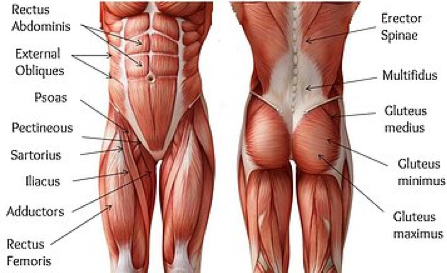
  • The core: the anatomical region comprised of the torso, pelvis, and hips, including the abs, obliques, spinal erectors, glutes, hip flexors, hip adductors, transverse abdominis, multifidus, diaphragm, etc. As the link between the lower and upper extremities, the role of the core is to transfer, generate, and absorb force between the upper and lower body.

  • Direct core training: any exercise for which the primary purpose is to train the core muscles to improve their size, strength, endurance, or control. Direct core training can come in many forms, from positional breathing to static exercises to dynamic ones, either where the limbs are moving around a stable trunk or the trunk itself is moving. (I'll give a few specific examples of each shortly.)

Now back to the who-are-you question. To aid introspection, here's a smattering of things you should ask yourself to guide your direct core training decision:
  • Are you a competitive athlete? A weekend warrior? A couch potato?
  • Do you want to lose weight? Get stronger? Reduce your risk of injury? Get on stage for a bodybuilding show?
  • Do you already have a strong midsection, or is it your weak link?
  • What types of exercises are you already doing, if any?
  • Do you enjoy direct core training?

In relation to those questions, let's consider some conditions under which you could benefit from direct core training:

Sunday, September 17, 2017

The Plank Variation That Saved All the Puppies

If there’s one exercise that sets the foundation for all others, it’s the front plank.

Think about it.

What’s a push-up? A moving plank. What’s a pull-up? A moving plank. What are we doing with our torsos during squats and deadlifts? Maintaining the flat back posture characteristic of, you guessed it, a plank!

Yet if there’s one exercise that’s notoriously butchered, it’s also the plank.

People often attempt to hold it for way too long (e.g. several minutes on end). And when they do, it’s usually ugly. They lose proper position (a straight line from head to heel) and, therefore, the desired training effect. They also kill all of the puppies in the process.


Over the last few years, likely in response to the puppy-killing plank epidemic, the RKC plank has emerged as a potential solution.

Wednesday, October 5, 2016

The Secret to Maximizing Strength and Muscle

Shannan Maciejewski was one of the first fitness people I connected with on social media many moons ago. Lucky for me, he’s also one of the good guys. Despite residing a million miles away (in Australia), his genuine, caring personality easily bridges the great divide.


Over the years, I’ve learned a hell of a lot from Shannan. Today, I’m honored to share an original guest post he wrote for my site. His “tension-volume knob” analogy is worth the price of admission alone (which is free since it’s my blog!). Enjoy! -TP


The Secret to Maximizing Strength and Muscle
Guest Post by Shannan Maciejewski

Have you ever experienced that moment in training when something just clicks?

It’s like an ‘aha’ moment where everything falls into place. From then on, it seems as if all the puzzling conversations, all the lead up work, and all the cues that once didn’t make sense, now for some reason do.

Understanding the importance of tension in training to maximize performance can be one of those times (especially specific to certain exercises).

As coaches, we often communicate the importance of certain focus points in relation to improved exercise execution with cues like
  • “Get tight.”
  • “Bend the bar.”
  • “Get the lats on.”
  • “Crush the bar.”
  • “Shoulders back.”

Oftentimes we find ourselves hammering these cues until the cows come home with little to no effect. It’s our job -- the art of coaching, if you will -- to figure out why our cueing is ineffective, and then devise a plan of attack.

It could be that they just don’t get what you’re putting out. In this case, it may be time for another cue, another demo, or a brand new approach to achieve the desired outcome.

That’s where today’s post comes in. 

Tuesday, October 20, 2015

AskMen.com: Reaching Your Muscular Potential


Hang out for any length of time in a commercial gym, and you're guaranteed to see atrocities like triple bodyweight quarter squats, push-ups that look like they're being performed by a dying seal, and eighteen variations of bicep curls.

In my new article for AskMen.com, Reaching Your Muscular Potential, I thought long and hard about the most common mistakes I see people make.

In the end, I was able to boil the list down to just six things. Are you making any of the six mistakes? Find out here:


Tuesday, October 6, 2015

Meet Mark: The Case for Online Training

Meet Mark. Mark is a 30-something father of two and administrator at a university.


Mark enjoys being active. His primary fitness goals are simple: to look good and continue engaging in recreational sports with his buddies.


Lately, Mark’s been experiencing a plateau with his resistance training routine, though. He’s tasked me, his online personal trainer, with evaluating his current program and making some recommendations to help him break out of his rut.

Monday, September 28, 2015

The Fitness Handbook: The Story of My Double Bodyweight Chin-up

​For as long as I can remember, I’ve had a knack for pull-ups. You might say I owe it partially to my physical difference. For bodyweight exercises, the congenital absence of my left leg is actually a blessing; my prosthetic leg weighs only a fraction of what a human limb does.

Back in elementary school, I remember testing max rep pull-ups in gym class each year. Cueing up some inner rage at whichever crush had recently broken my young, naïve heart, my seven or so reps consistently scored tops among my peers. Being sore in the biceps for days thereafter was like my badge of honor.

Fast forward a decade and change to my mid-20’s, when double digit pull-ups became my norm. Needing a new challenge, I began adding extra weight via a dip belt. One day, about three years ago, I decided to test my one-rep max. After a thorough warm-up, I threw 90 pounds on the belt and asked my co-worker to film my attempt. Surprising even myself, I busted out three reps.

​And so a new quest was born: a double bodyweight chin-up....

Read the rest of my article for The Fitness Handbook here:


Sunday, August 2, 2015

T Nation: 5 Ways You're Wasting Time in the Gym

If you're anything like me, you love lifting weights. It’s the best part of your day. There’s no finer feeling than the blood coursing through your veins, no finer sound than metal clanking against the floor. But when your life starts to revolve around three-hour marathon gym sessions, you’re no longer getting the most out of your training.

Though your intentions are pure when it comes to these all-day exercise affairs, your results are suffering. You see, building muscle depends on a delicate hormonal balance. Anabolic, or muscle-building, hormones are released at the onset of training, and catabolic, or muscle-wasting, hormones are released around 40 minutes in. Spend much more than an hour pumping iron, and you start tipping the scale in the wrong direction.

It’s easy to fall into this trap. We’ve all been there. One minute you’re warming up; the next you’re only halfway through your workout, it’s two hours later, and you’re late for dinner. Through a combination of improper warm-up, suboptimal exercise selection, and idle rest periods, you’ve managed to turn what should have been a gym quickie into some sort of tantric chest and triceps experience.

With a little extra attention to detail, though, you can get back to building serious muscle without the full-time plus overtime commitment. In my latest T Nation article, I chronicle 5 Ways You're Wasting Time in the Gym -- and what to do about themRead it here:

>>https://www.t-nation.com/training/5-ways-youre-wasting-time-in-the-gym<<


Monday, May 18, 2015

thePTDC.com: The 10 Most Hotly Debated Fitness Topics


These days, many fitness professionals are quick to adopt polarizing, black-and-white stances on hot topics. While sweeping generalizations do tend to stir up controversy -- thereby bringing the renegade coach/trainer to the fore in a fairly flooded market -- they also cloud the general exercising public’s judgement.

  • “Will just squatting fix my wonky squat, or should I spend an hour rolling around on the floor?"

  • “Are squats, deadlifts, and pull-ups enough to train my core, or do I need additional exercises that work it more directly?”

  • “Does high-intensity interval training take care of all my conditioning needs, or would I be better served with steady state cardio?”
Of course, no one in a position of exercise authority wants to come across as wishy-washy on an important subject. But the truth is that most issues in this business exist on a continuum. As such, it’s best to adopt the middle ground the majority of the time.

In my new article for The Personal Trainer Development Center, ‘The 10 Most Hotly Debated Fitness Topics,’ I advocate for a more tempered approach to some of the most polarizing false dichotomies plaguing the industry today.

Read all about it here:


Tuesday, February 17, 2015

Brief Lessons in Biomechanics: The Abs as “Anti-extensors” of the Core

What do the front plank, overhead press, and pull-up all have in common?


On the surface, not a heck of a lot. One is an “ab” exercise, another is an upper body vertical push, and the other is an upper body vertical pull. 


But if we take a closer look, we may just find some common ground after all.


In the front plank, the long axis of the body is oriented at a right angle to gravity. If we were to relax in this position, gravity would pull our hips straight down, causing our low back to hyperextend, or arch.

Good form, or not so much?

The purpose of the plank, then, is to counteract gravity’s pull through a strong contraction of the abdominals and glutes. For this reason, you may hear the abs termed “anti-extensors” of the core and the plank an “anti-extension” exercise.

So what about the guy or girl planking it out for minutes at time (typically while scrolling through their Instagram feed)? Are they squeezing their abs and glutes tight like they should be? Or are they relying on the passive structures of their low back (tendons, ligaments, vertebrae) to keep their hips off the floor?

Sunday, February 8, 2015

Guest Post: Core Training: Fact or Fiction?

by Kennet Waale


I want you to think about this phrase for a second:

“Move Better At 60 Years of Age Than You Currently Are.”

What do you attach to that? How would you feel if you could do exactly that, but more importantly, WHO would you be if you could Move Better At 60 Years of Age Than You Currently Are?

During our recent “Rehab X: Post-Rehabilitation and Injury Prevention” workshop, we had numerous therapists and trainers in the room. Needless to say, we shared a lot of experience and great insights into numerous relevant topics. One of the topics I felt needed to be covered was that of core training. The current state of the fitness industry (though slowly improving) is all about making money and not so much about sharing quality information helping individuals understand the true power of knowledge and implementation. It is for this reason I will share with you some eye-opening thoughts around the topic of core training -- and if there’s any sound evidence behind it whatsoever.


Friday, January 23, 2015

A Case of the Tilt

Everything’s cool when you’re just chilling with your arms at your sides. Posture’s good: ribs are down, pelvis and lumbar spine are neutral (or close enough to it), breathing is normal.


Something crazy happens, though, whenever you go to pick heavy stuff up off the floor and press it over your head. All of a sudden, you turn into Donald Duck!


Credits to Bret Contreras for the Donald Duck imagery.


What caused this cartoon metamorphosis? You lost your neutral posture. Your ribs flared up, your low back arched, you stopped breathing into your deep belly, and you went into a nasty anterior pelvic tilt.


Geez Louise, what’s anterior pelvic tilt? Sounds like some sort of airborne illness. Quick, call 9-1-1!


Not so fast, cowboy. We just might be able to reel this bad boy in without the help of the paramedics.

Thursday, January 15, 2015

Brief Lessons in Biomechanics: Taking Care of the Spine

Hi! I’m your friendly neighborhood biomechanist, the Fitness Pollenator, and I’m here to impart some quick lessons on how to take care of your spine. Enjoy!


The Importance of A Neutral Spine


Just about everybody knows that picking things up off the floor with a round back is dangerous, but did you know that an overly arched back can be just as bad?

The resultant force due to gravity always acts straight down. Viewed from the spine, this force can be broken down into two components:

(1) a compressive force that pushes the vertebrae together along their longitudinal axis, which the spine tolerates well, and

(2) a shear force that pulls the vertebrae apart transversely, which the spine doesn’t like nearly as much.

In the image above, you can see that the size of the resultant force due to gravity is the same for both the neutral spine and the arched spine. However, that nasty shear component is clearly larger for the arched spine than the neutral one.

Maintaining a neutral spine position (by tightening the abs and glutes) during both bending and overhead movements means that more of the force gets transmitted through compression as opposed to shear, keeping you safer and pain-free.

Wednesday, October 1, 2014

How Top Fitness Pro's Coach Leg Position on Pull-ups

When it comes to leg position on pull-ups and chin-ups, we have a boatload of options, including knees bent, legs straight, and hips piked. With so many positions to choose from (if you know what I mean!), I've long pondered the merits of each.


Wait a second, you may be thinking. Aren’t pull-ups a back exercise? Why’s this guy wasting his time worrying about what the legs are doing? Is it because he’s missing one and that’s causing him to overcompensate?

Thursday, September 4, 2014

EricCressey.com: “If Only:” 7 Lessons from a Record-Setting Paralympic Medalist

Sure, all newbie lifters make mistakes. But just maybe, with the proper information, many of these mistakes could be avoided. At least, that was my goal for this guest post I did for world-renowned strength coach (and all-around cool guy!) Eric Cressey.

Read about the seven biggest mistakes I made in the weight room during my Paralympic swimming career here:


http://www.ericcressey.com/if-only-7-lessons-paralympic-medalist

...But don't take my word for it! This post was also featured in the Personal Trainer Development Center's Top Fitness Articles of the Week (August 31, 2014, edition):

http://www.theptdc.com/2014/08/top-fitness-articles-week-august-31-2014/


Wednesday, September 3, 2014

BretContreras.com: Lower Body Training for the Amputee and Able-bodied Athlete Alike

My resistance training journey began one fateful evening, a decade ago, in a crowded high school weight room. My teammates and I, still dripping wet from swim practice, gathered around the athletic trainer as he attempted to explain the intricacies of the barbell high pull.


Fancying myself no different from my peers -- despite having been born an above-knee amputee as a result of a congenital birth defect -- I approached the bar and got to work on my first set. It didn’t feel quite right, but nobody said anything, so I figured I was doing okay. I did a couple more sets in a similar fashion and then headed home.


Lo and behold, my efforts to mainstream myself had some nasty repercussions. I woke up the next morning with excruciating low back pain and was relegated to the plate-loaded deadlift machine for the rest of the season. It wouldn’t be until eight years later that I would gather the courage to attempt another barbell lift.

What went wrong that first day? Likely a bad case of lumbar flexion, in addition to a gross compensatory pattern favoring my intact side. Could it have been avoided? With careful exercise selection and implementation, yes.

The trouble is, there's a serious lack of strength training info out there for us amputee athletes. As such, I've taken it upon myself to develop a catalog of lower body exercises geared towards the amputee -- as well as anyone looking to develop strength and symmetry in their hamstrings and glutes. And come on, who doesn't want a better backside?!

This resource is now complete and available to the masses. It even includes over a dozen short and sweet videos of me performing all the exercises.

Here's the link:

http://bretcontreras.com/lower-body-training-amputee-able-bodied-athlete-alike/


Monday, August 18, 2014

GregOhnoez.com: Back to the Basics

Hopefully, you've already received your copy of my free e-book, The Big Six Made Simple: A Guide to the Basic Barbell Lifts. (If not, just sign up for my mailing list at the top of this page!). You might still have some questions, though, about exactly how to structure your workouts around The Big Six.

Fear not. In this guest post for my friend Greg Ohnoez, I've created a simple, straightforward program designed to get you great results with a barbell alone. Try it today, and let me know what you think!


Monday, August 11, 2014

BretContreras.com: Which Glute Bridge is Best? An Amputee Case Study


I'm tremendously excited to share the link to my first guest blog post for The Glute Guy, Bret Contreras! Not only is Bret a wicked smart leader in the fitness industry, but he's also a terrifically nice guy.


My post chronicles a case study I did using EMG to determine which bodyweight glute bridging variation is best. It's a little heavy on the science side of things, but I know you'll enjoy it!


Friday, August 8, 2014

Men's Health: Man Performs Feat of Strength That Will Amaze You


Check out this article by Adam Campbell for Men's Health all about me and my "amazing feat of strength," the hanging dragon flag. Who would've thought?! 


http://www.menshealth.com/fitness/hanging-dragon-flag