Saturday, October 6, 2018

Guardian of Science [The Fitness Devil Podcast]


The other day I had the great pleasure of appearing on the Fitness Devil Podcast with hosts Andrew Coates and Dean GuedoOver the course of an hour, we spanned topics like
  • Injury prevention for gym goers and athletes
  • The utility of core training
  • My Paralympic swimming career
  • "Good" and "bad" exercises (for people over 50)
  • Misinformation in the fitness industry
  • Strategies for improving fitness professionals' communication with the masses

The episode, titled "Guardian of Science," is available now at the following link (or wherever you download podcasts):


Tuesday, October 2, 2018

Is Some Injury Risk Factor Research Worthless?


I recently read an interesting 2016 paper by Clifton et al. in the Journal of Athletic Training called Predicting Injury: Challenges in Prospective Injury Risk Factor Identification.

The premise of the paper is that some researchers screw up when concluding they've identified risk factors for injury. In the paper, the authors describe two of the most common screwups and how to address them.

Before I get to the screwups, a quick explanation is in order regarding the correct way to identify risk factors for injury, which is through a prospective study. It can be summed up in three steps:
Step 1. Examine a group of uninjured athletes at baseline (i.e. in the pre-season). 
Step 2. Track their injuries prospectively (i.e. over a period of time, usually a competitive season). 
Step 3. At the end of the study, break the sample into two groups -- the athletes who got injured and the athletes who didn’t -- and look for differences between the groups in their baseline measures.
And now for the common screwups, as per Clifton et al.:

Common Screwup #1) Retrospective Study Design

Prospective injury studies are difficult to do because they require careful and consistent follow-up regarding injury. A much easier approach is a “retrospective” one. With this type of study, you simply assess a group of athletes with and without injuries and compare the groups based on these previous injuries. With this design, there’s no need to follow the athletes over time.

The mistake that’s commonly made comes with the interpretation of the retrospective study. Researchers will often state that measures on which the injured athletes performed worse are risk factors for injury. The trouble is, there’s no way to know whether those factors were present prior to the injury OR if they are actually the result of the injury.

This isn’t to say retrospective research is worthless. It’s just that follow-up studies with prospective designs are needed to determine whether the differences seen in retrospect are true risk factors for injury prospectively.

Tuesday, August 28, 2018

Do You Need Direct Core Training?


Expert marketers have long known that two things sell better than most anything else: sex and absolutisms. Unfortunately, dear reader, this blog post isn't either of those. As polarizing and juicy as it would be to write about how you should "NEVER do crunches again" or "the one core exercise EVERYONE should be doing," none of that stuff is true.

The only way to answer the question of whether YOU need direct core training is to identify who "you" are.

Before we do that, though, let's get on the same page about what I mean by the core and direct core training:
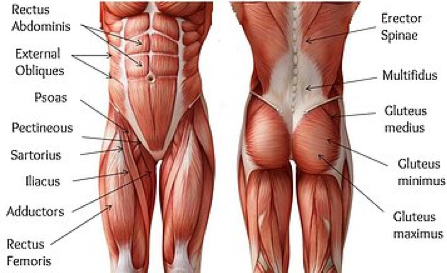
  • The core: the anatomical region comprised of the torso, pelvis, and hips, including the abs, obliques, spinal erectors, glutes, hip flexors, hip adductors, transverse abdominis, multifidus, diaphragm, etc. As the link between the lower and upper extremities, the role of the core is to transfer, generate, and absorb force between the upper and lower body.

  • Direct core training: any exercise for which the primary purpose is to train the core muscles to improve their size, strength, endurance, or control. Direct core training can come in many forms, from positional breathing to static exercises to dynamic ones, either where the limbs are moving around a stable trunk or the trunk itself is moving. (I'll give a few specific examples of each shortly.)

Now back to the who-are-you question. To aid introspection, here's a smattering of things you should ask yourself to guide your direct core training decision:
  • Are you a competitive athlete? A weekend warrior? A couch potato?
  • Do you want to lose weight? Get stronger? Reduce your risk of injury? Get on stage for a bodybuilding show?
  • Do you already have a strong midsection, or is it your weak link?
  • What types of exercises are you already doing, if any?
  • Do you enjoy direct core training?

In relation to those questions, let's consider some conditions under which you could benefit from direct core training:

Monday, July 9, 2018

How to Design a Workout Program [Free Webinar]


A few months ago, I was asked to deliver the exercise prescription lecture for the 2nd year Doctor of Physical Therapy students at my university.

In preparation for the talk, I spent a good chunk of time reflecting on my own process for designing training programs versus what the textbooks recommend.

I knew this would be one of the students’ only exposures to the topic. So I wanted to pass on as much essential information as I could in the hour and change I had with the students.

The lecture was a hit, so I decided to make a recorded version of it so more people could benefit. Here it is in all its glory. Please don’t hesitate to reach out with questions.

Monday, May 21, 2018

How to Train More Without Getting Hurt [SimpliFaster]


Training for peak performance is tricky business. Push too hard, and you get hurt. Don’t push hard enough, and you still get hurt (from being unprepared for the rigors of competition).

Luckily, there’s a new way to measure how hard you’re working. And amazingly, the research shows it actually protects against injury. That’s right: sports scientists have finally figured out How to Train More Without Getting Hurt.

I break down all the latest research -- and show how to implement it -- in my brand new article for SimpliFaster: